
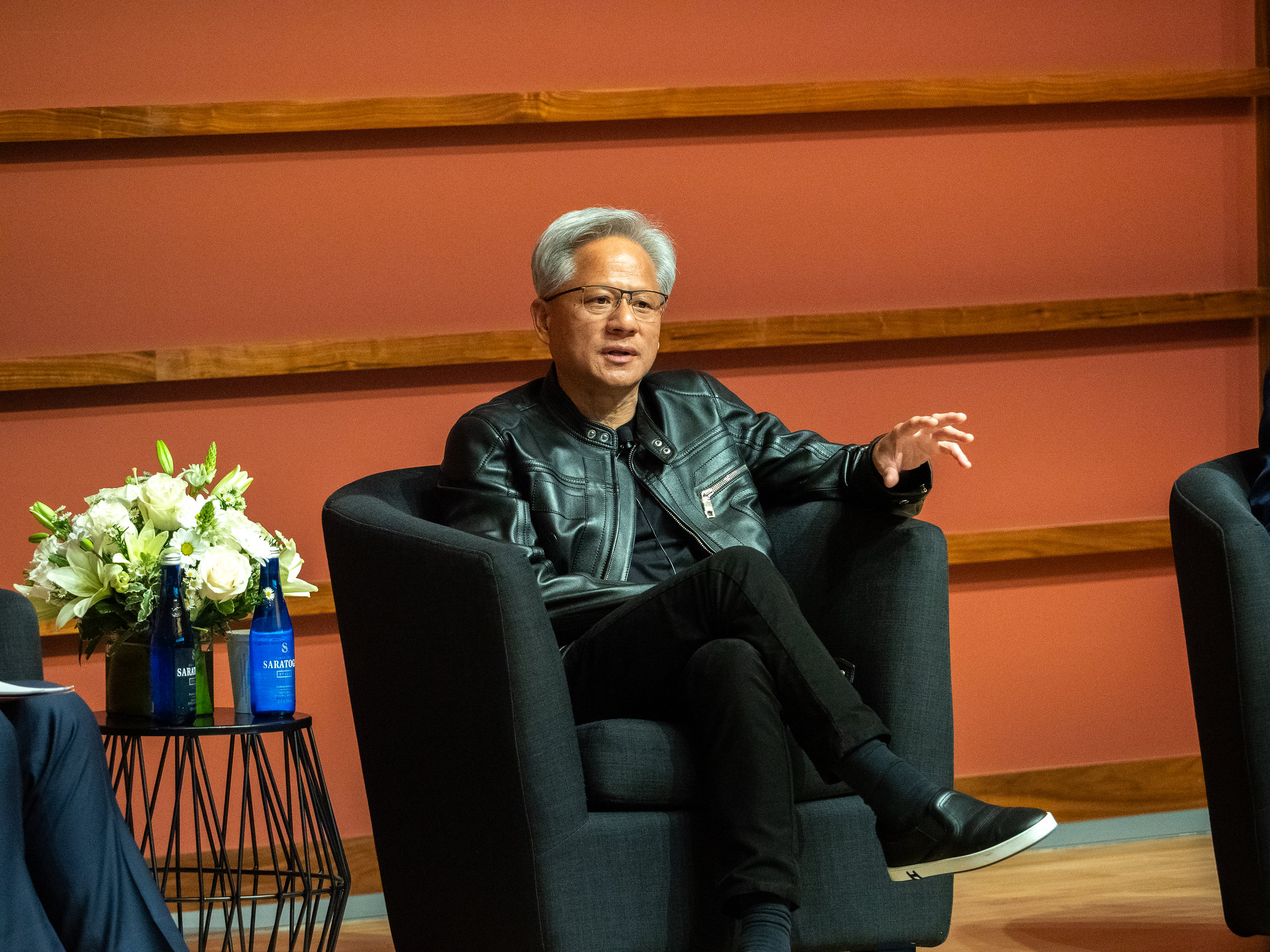
Why succession planning is a core strategic pillar for boards.
By Caroline Stokes, Author of AfterShock to 2030: A CEO’s Guide to Reinvention in the Age of AI, Climate, and Societal Collapse
Jensen Huang’s rapid reinstatement at Nvidia, much like Sam Altman’s 2023 return to OpenAI, underscores a new reality for boards: in the middle of an AI arms race, founder identity and market stability are inextricably linked.
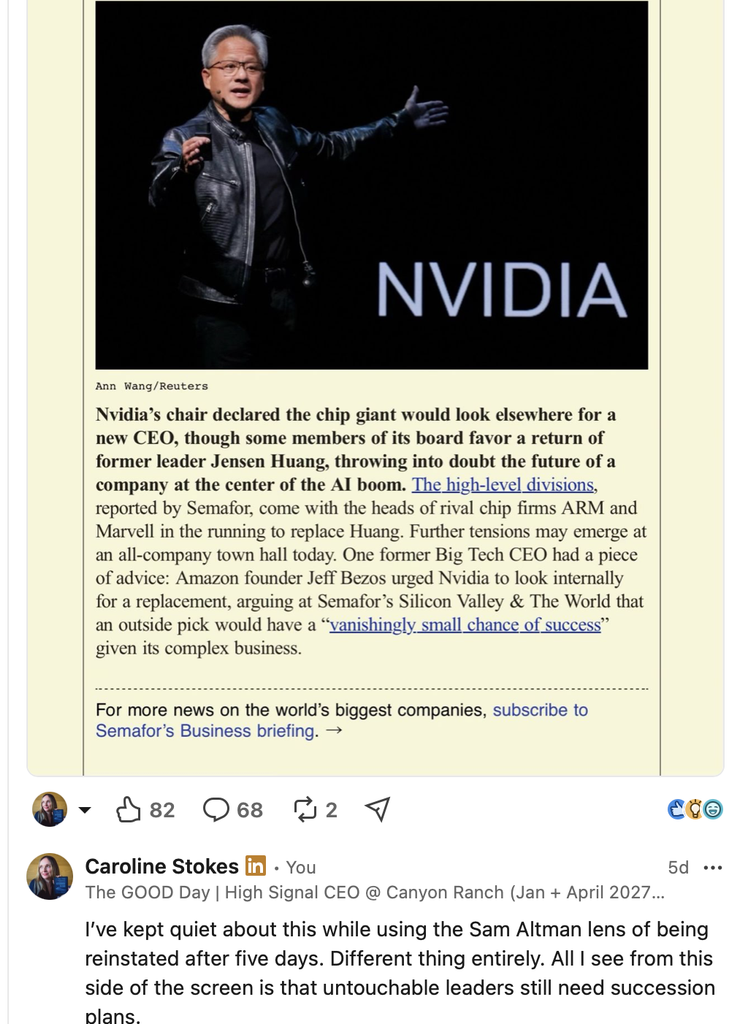
I expected a faster Huang return and patiently kept quiet online (see my comment on this LinkedIn post). Some thought it might take a year; it took 11 days. In the pre-mobile era this kind of resolution took far longer; Steve Jobs was away from Apple for 12 years. I’ve been saying this for a while: we are in a new paradigm. For organizations outside an arms race of this kind, it would have taken longer. Why? When a company like Nvidia is part of critical global infrastructure, this is just how it goes.
What concerned me was how deeply Nvidia’s move reflected old-paradigm governance. In prioritizing optics and accountability to pressure Huang into resigning, the board sidelined an irreplaceable driver of the AI industry. They created a massive shock and risked losing the most important figurehead due to an embarrassing, low-trust situation.
There’s a fierce and fast hunger for justice now. Just look at Theranos: the first major public exposé in 2015 took years to resolve. The 2020s brought a whole new flavour of wild when FTX collapsed in roughly nine days. Unlike FTX, Huang’s actions didn’t bankrupt the company or cost customers their money. But the crisis put Nvidia under intense national security and governance scrutiny.
If you’re a board member, or a CEO outside the Fortune 100 or AI-native club, you are unlikely to be able to count on a founder’s return. These latest events demonstrate one thing above all: failing to implement a proactive succession strategy leaves almost any board highly exposed and organizational longevity at risk.
In ecoDa’s recent Complex Thinking at Board Level paper, we noted that board succession often lags behind executive succession. Formal pipelines are rare, director tenures are longer, and nominations rely on existing networks. A broader generational base helps close those gaps.
At IEEE-USA’s BiG Thinkers, I spoke about the practical pressure this creates. US Bureau of Labor Statistics data show roughly one in three architectural and engineering managers is already 55 or older. Broader analyses put 42% of S&P 500 CEOs at 60 or older, with roughly a third of companies seeing both the CEO and CFO inside the retirement window at the same time. Spencer Stuart notes that 35% of S&P 500 independent directors are 72 or older or have served a decade or more. Boards are already uncomfortable with a thin bench.
So what are you going to do about it?
My advice to boards: embed real succession planning and dual-horizon oversight today. Otherwise, continuity pressures will always hijack broader strategic priorities.
For CEOs who want to work on dual-horizon planning in a setting designed for new thinking in this era, I’m hosting a small session at Canyon Ranch in January 2027. Contact me for details.