


I plan to support the shift many people say they want to see in the world, starting with those at the top. How about you?
By Caroline Stokes, Author of AfterShock to 2030: A CEO’s Guide to Reinvention in the Age of AI, Climate, and Societal Collapse
[Scroll to the end if you’d like to get my manifesto for leaders.]
Happy holidays — and I hope you’re in the mood to make some good trouble in 2026.
2025 turned out to be healthy, creative, and productive.
I lifted scarily heavy weights.
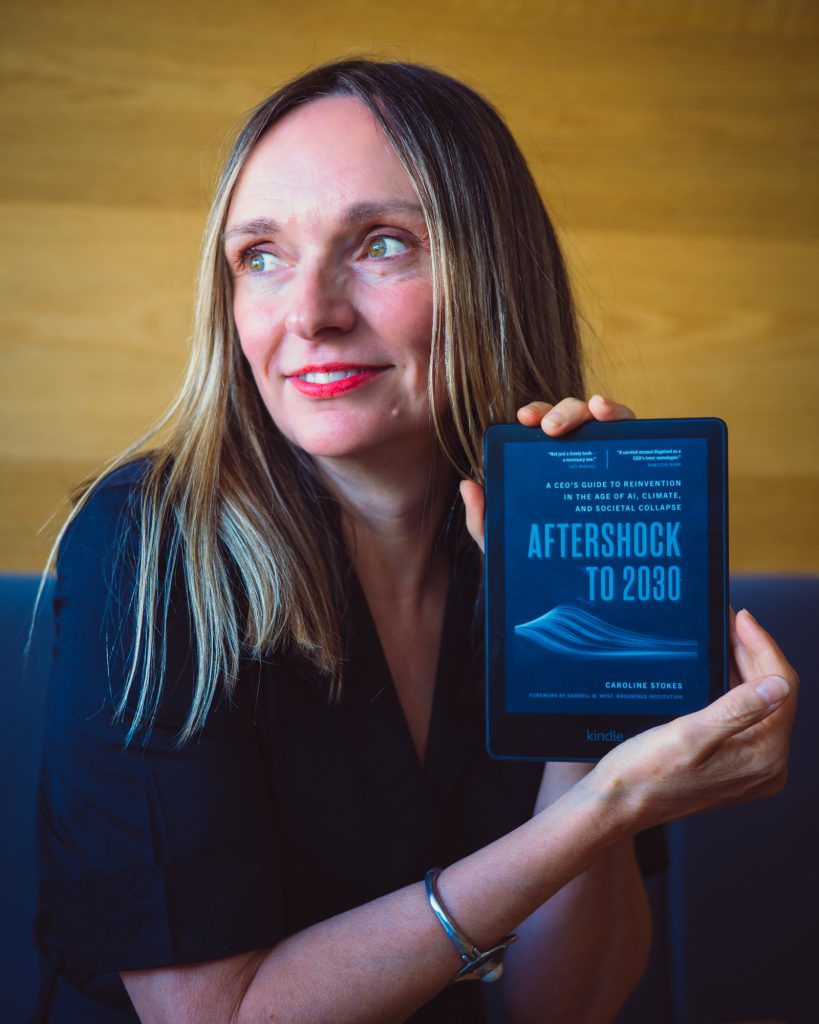
I launched AfterShock to 2030 — a book for CEOs who’ve realized that our complex AI, climate, and societal reality now demands entirely new leadership. The world is quite literally asking CEOs to reinvent.
I launched a podcast focused on helping leaders evolve into the Fifth Industrial Revolution.
I was nominated for a Thinkers50 Leadership Award.
Once I finished my book, I started working with senior leadership teams through this transition — primarily via focused 100-day reinvention programs. They’re intense, because catalytic change requires an upgrade sprint, not wait-and-see, standby mode.
So, how are you really feeling about 2026?
For many, the “new year, new you” ritual is an eyerolling hope/failure loop on repeat. Most good intentions lose momentum within days or weeks.
At this age (nearing 54), I’ve realized I approach things differently.
I decide what I’m going to learn — ahead of megatrends.
Over the past five years — including studying at MIT twice (AI for Business Strategy and Sustainable Business Strategy) — I’ve treated reinvention or reskilling and improving my systems thinking as the most exciting and invigorating thing I can do. Dare I say “fun”!?
For fun over Christmas, I’m taking MIT’s New Space Economy: Technologies, Products, Services, and Business Models certification.
As you probably know, the Reagan administration committed in 1983 to making GPS — a US Department of Defense satellite system originally developed for the military — available for civilian use. That’s when space tech started to become an everyday part of our lives.
Learning about new products and business models will, sooner or later, be layered over current business needs to upskill and reinvent. I see this as a cutting-edge way to provide additional consulting services for leaders and their organizations.
Back down to earth and moving into 2026, I’ve landed on three themes that I hope infect your thinking a little:
1. The old paradigm is dead-dead.
Anyone unwilling to face what’s now and what’s next with an irreverent “let’s learn and get this done” mindset will feel increasingly disoriented and disconnected. And I’m not talking performative leadership theatre.
It starts with listening to how you talk to yourself and others. Your decisions.
The moment you feel trapped or sound like a victim, that’s your signal to move forward with intent.
The moment you catch yourself in a negativity loop, interrupt it by learning something — fast.
Please don’t lose yourself. Time is our only constraint in a world where we can learn anything and implement it really fast. That’s why my book expects leaders and organizations to radically reinvent by 2030. My podcast guest, Darrell M. West of Brookings, called for the timeframe to be even shorter.
2. Human disconnection is accelerating faster than the tech — and I won’t stand for it.
Esther Perel and Scott Galloway discussed this in a podcast back in August. When seclusion, loneliness, fear of saying the wrong thing, and fear of awkwardness are layered on top of AI acceleration, climate stress, and societal fracture, we are heading toward an extinction event.
The antidote is partly in my book. That’s the spirit of making good trouble.
And in 2026, I’m taking it further.
I’m going to spend more time with people in the same room, not just digital communities. I’m now tracking it with pen and paper as I’m convinced I don’t need an app for that. I’ll be monitoring my human-to-human (H2H) connection quota on a series of lo-fi Post-its on my fridge. Hope you find a way to boost your H2H quota, too.
Where to start?
I noticed that most of my long-term friendships started digitally. They became real because we did small, unexpected, unsolicited things for each other, in different ways, over time. I’m grateful to everyone who has been in my orbit, and I hope to invite more into it in 2026, too.
Approaching 54, I’ve decided I’m going to travel more in 2026. Not because I have a bucket list. I do, but I’ve decided H2H is more important right now. To be inspired by human connection, learning, growth, and the good chemicals it produces is a very wonderful thing.
I do feel an unusual surge of urgency, though. I might have five good years. Ten? If really lucky, 20? So, for me, 2026 is about connecting and evolving mindsets for the deeply complex environments we’re living in.
3. I’m going to be speaking up more.
I did not see this one coming.
At Thinkers50 in London, I told Marshall Goldsmith and Michael Bungay Stanier I didn’t want to stand on stages doing the whole “listen-to-me guru” thing.
My logic: people feel energized when they hear a story, but having previously spent over $10K sitting in a TED auditorium for a week back in 2023, I found that insights disappear as soon as the next person steps onstage. Yes, the insights blur and fresh neurons create a new reality in the mind which affects how we interact with the world. But all I really wanted to do in 2026 was to roll my sleeves up with senior leadership teams to help them move from one paradigm to the next.
Marshall and Michael pushed back — in a nice, coach-y way, of course.
Then, less than 12 hours later, Chartwell Speakers reached out to represent me. They work with people like Cory Doctorow, Amy Webb, and others shaping how we think about technology, power, and our current horizon.
I immediately said yes, because I need — we need — CEOs and their senior leadership teams to change course. When climate strategy and safeguards are being dismantled and AI is evolving our ability to understand what the heck is going on, I realized not speaking would be the wrong decision.
So I’ll keep doing my thing, lifting heavy weights in the gym, learning, doing fractional senior leadership reinvention work and supporting the shift many people say they want to see in the world, starting with those at the top. That’s my 2026 jam. What’s yours?
Have a great holiday with family and friends, and I do hope you’ll create very good trouble with me in 2026.
Caroline
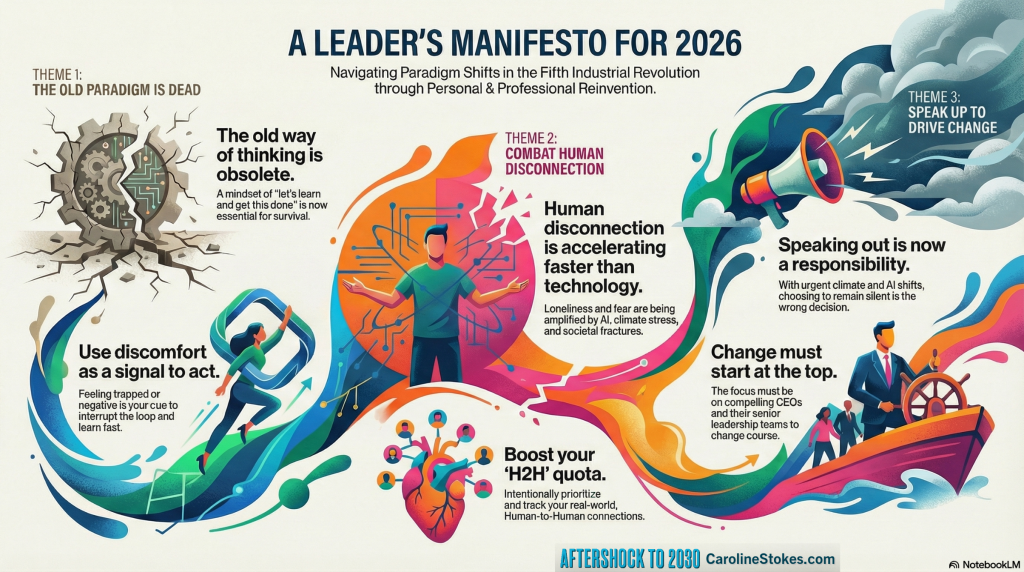
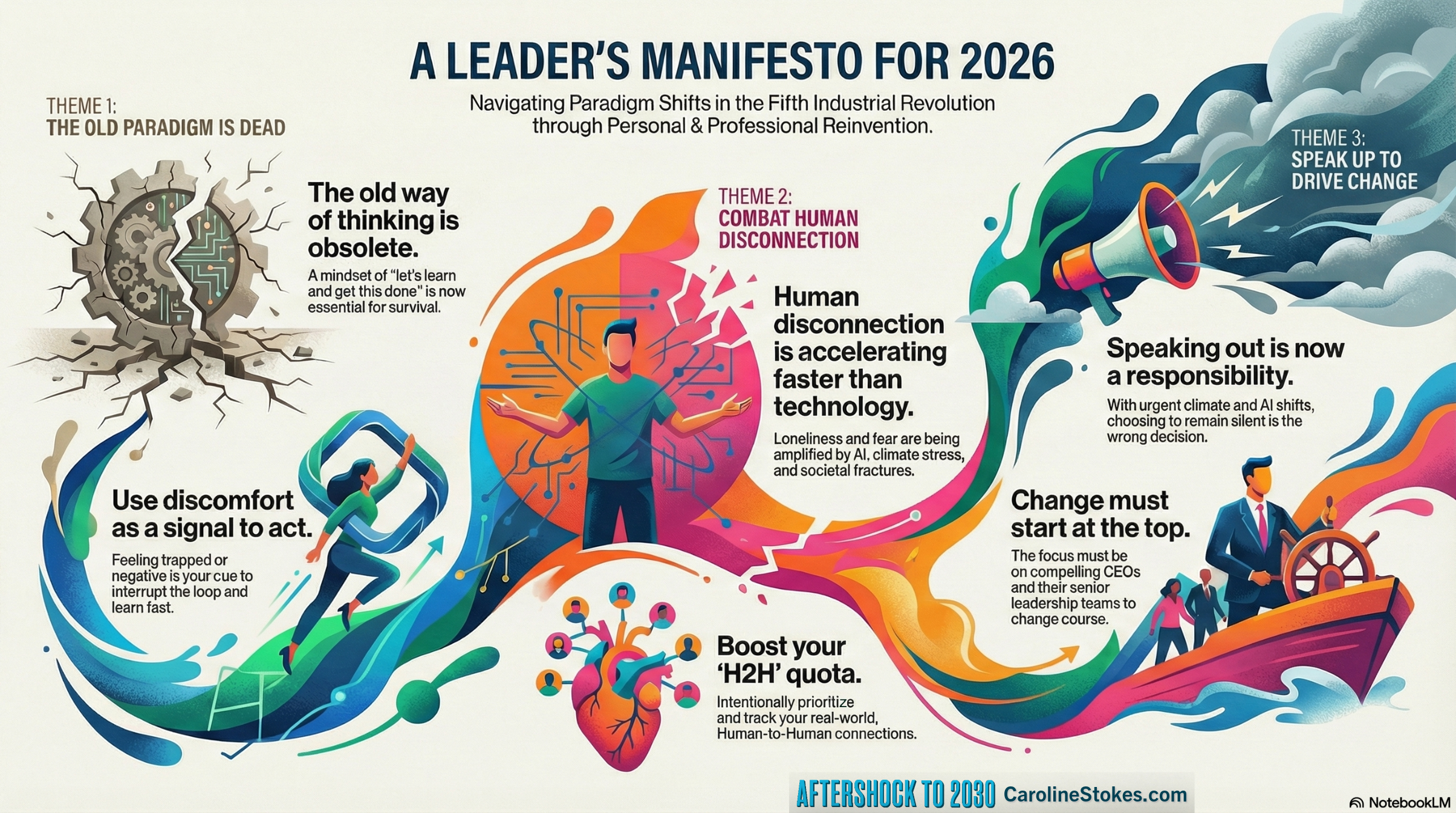
PS: I was introduced to NotebookLM recently, and it created this infographic based on this post. Feel free to use it for your teams or yourself as you think about 2026.

Leave a Reply