
Why CEOs must reinvent themselves in the age of AI, climate, and societal strain.
By Caroline Stokes, Author of AfterShock to 2030: A CEO’s Guide to Reinvention in the Age of AI, Climate, and Societal Collapse
If you turned on the news this week, or last week, or even for two minutes today, you will have determined we are not living through a normal cycle of disruption.
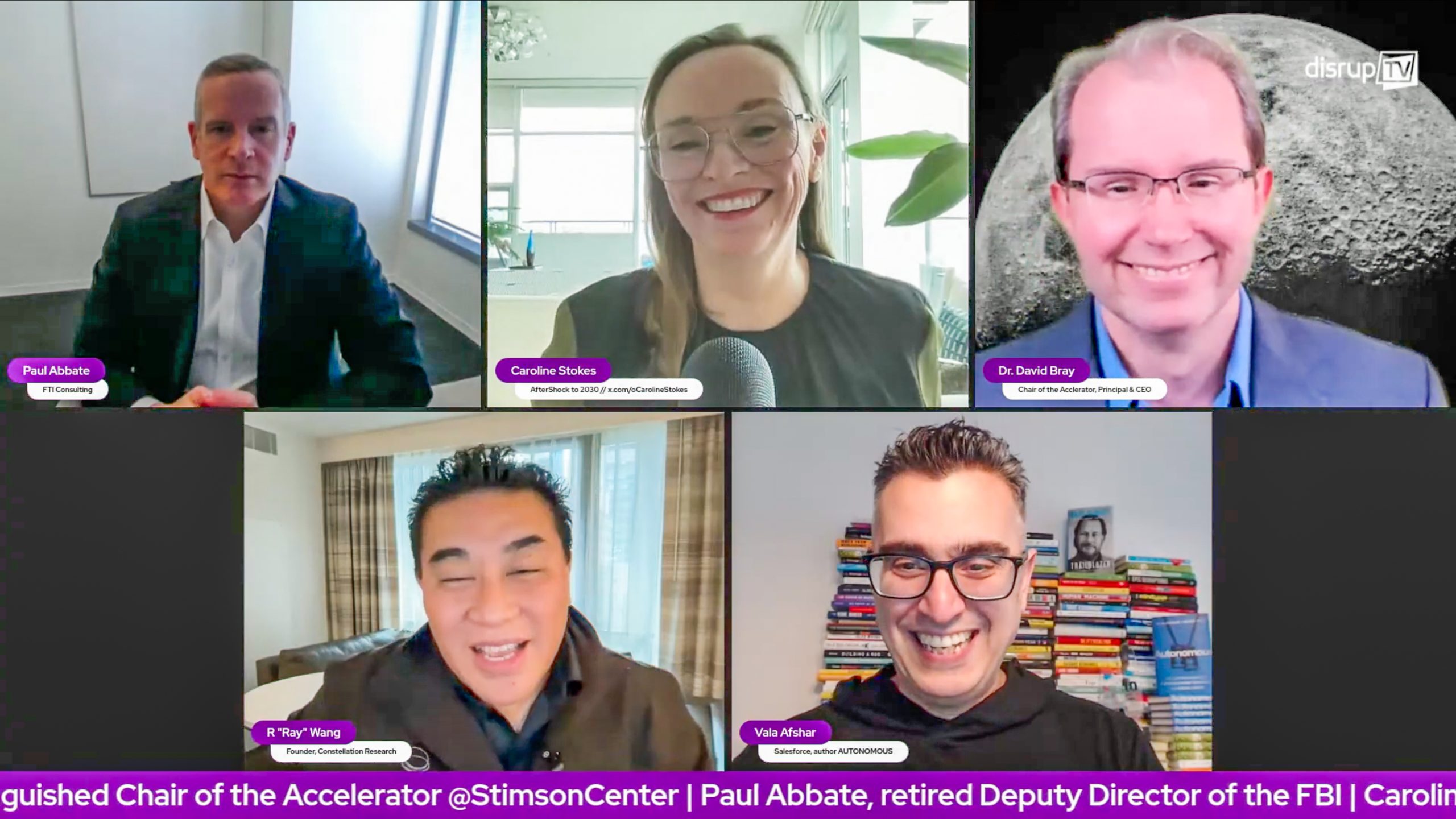
Following my recent DisrupTV appearance alongside former FBI Deputy Director Paul Abbate and Dr. David Bray (CEO, Lido Adapt Ventures), I wanted to underscore that this is not a moment to be solved with better quarterly planning, sharper communications, or another leadership offsite. We are living through a convergence of forces — AI acceleration, climate instability, geopolitical tension, and social fragmentation — that are reshaping what leadership actually requires.
I call it the AfterShock. We’re entering the fifth industrial revolution in which humans and AI need to work together within new economic rules to create solutions within planetary limits.
You may have heard of Jamais Cascio’s BANI or EY’s NAVI. Economic historian Adam Tooze has described this as a polycrisis. Whatever the description, we can all agree that we are in a time where there is not one single disruption, but multiple, interacting systems under strain and a series of aftershocks since the pandemic. Thinkers like Thomas Homer-Dixon have similarly warned of cascading failures across interconnected systems.
We know this, but few are adapting mindsets to scale as most leadership models still assume stability. At the same time, for many, the gap between leadership mindset and multi-system intelligence is growing.
The job has changed
One of the most under-discussed business stories of the past few years has been the rising number of CEOs stepping down, way beyond routine turnover — reflecting a reinvention of CEO and leadership design.
Today’s leaders are expected to understand AI well enough to shape strategy, navigate climate risk and systemic fragility, anticipate geopolitical disruption, and lead workforces under sustained psychological strain.
Rita McGrath has argued through her work on “transient advantage” that the idea of stable competitive positioning has eroded. Just like the call in my book, Gary Hamel has gone further, calling for a reinvention of management itself.
What we are seeing now is that leadership has not kept pace with that reality, and expertise alone is no longer enough.
So, what’s the answer?
Synthesis + polymathic leadership = power
In an AI-enabled world, access to knowledge is no longer a differentiator. What matters now is the ability to synthesize across domains — to connect dots others don’t yet see.
This is where polymathic leadership becomes essential.
Polymathic leaders think across systems, integrate technological, human, and strategic perspectives, anticipate second- and third-order effects and bring everyone along for rapid execution.
This is not a new idea. Back in 1990, Peter Senge introduced systems thinking, which — even during my CEC training in 2013 — seemed to be ignored by most of the large organizations I’d worked for, as it if was an inconvenience. And Nassim Nicholas Taleb has long warned about the dangers of linear thinking in nonlinear systems.
What is new is the urgency.
Whether people are consciously aware of it, AI is reshaping how decisions are made, how quickly they are made, and who gets to make them.
As Erik Brynjolfsson and Satya Nadella have both emphasized, AI is both a productivity tool and a structural shift in how organizations operate. As NVIDIA says, they focus on “the mission is the boss” — the mission above all else. That means adapting from old, political systems into mission-focused systems. This may be hard for many leaders who know how to adapt organizations to their will instead of for business sustainability.
Speed vs. trust
AI introduces a profound leadership tension. A small number of individuals can now solve complex problems at extraordinary speed. But organizations still move at the speed of trust – or lack of it.
That gap is where many transformations fail. The imagery I shared on the DisrupTV podcast was that a CEO may be well positioned metaphorically to jump the Grand Canyon in half a day using AI. But everyone else is still making their way through the canyon on foot.
If leaders cannot bring people with them — through communication, trust, and shared understanding — they will create fragmentation rather than progress.
This is where research from Amy Edmondson becomes critical. Psychological safety is not a cultural nice-to-have, it’s an essential — vital — operational infrastructure that organizations need to prioritize. A quick way to understand psychological safety is whether someone will speak up towards the organization’s goals and first principles without fear it will impact them.
Without psychological safety, people disengage, withhold information, and resist change especially in environments moving at the speed of AI.
The nervous system is now a leadership variable
We are also underestimating something more fundamental: human capacity.
The modern workforce is absorbing constant digital stimulation, geopolitical instability, economic volatility and uncertainty, climate grief, hopelessness and anxiety, and rapidly changing AI disruption narratives.
This creates a level of cognitive and emotional load that directly impacts decision-making.
The US Surgeon General Vivek Murthy has already identified a global loneliness epidemic. Social psychologist Jonathan Haidt has pointed to the destabilizing effects of modern information environments on human behavior.
As I write in my book, if we look at mental health as mental sovereignty leading to business performance, boards, CEOs and managers might see the ROI on this approach.
We know it ourselves: when nervous systems are overloaded, abilities and health degrade and organizations become brittle.
Leadership today must therefore extend beyond strategy and execution. It must include the ability to create conditions where people can think clearly, collaborate effectively, and remain grounded under pressure. Otherwise, AI will show up as a failure.
Boards need their own reckoning
On DisrupTV, we noted that it is easy to place the burden on CEOs. But boards must also confront their own role.
Many boards were designed for an era of predictability, financial oversight and incremental change. With the news that Lloyds Banking Group has AI in the boardroom, it’s a clear signal that boards must radically evolve and have their assumptions challenged across AI risk and opportunity, cyber and geopolitical threats, cultural and societal expectations and systemic uncertainty.
As leadership expert Herminia Ibarra has shown, identity transformation is central to leadership change. That applies not only to CEOs — but to boards themselves.
If boards expect reinvention, they must model it. Lloyds Banking Group seems to be leading the way.
Purpose is not optional
Many leaders are overwhelmed, retreating and becoming disconnected.
This is one reason leadership feels increasingly lonely. Without purpose, leadership becomes reactive, defensive, exhausting.
Leaders like Hubert Joly have demonstrated that purpose is not a branding exercise or a mission statement, but a strategic and human anchor.
In an environment of constant disruption, purpose provides clarity amid noise and resilience under pressure and, for boards to understand it from an ROI perspective, a basis for decision-making beyond short-term metrics.
The real mandate
Too many organizations are still attempting to preserve old structures while layering AI on top.
The organizations that will succeed are those willing to redesign leadership capability, governance structures, cultural norms and decision-making for this new world.
This requires leaders who can think systemically, act decisively amid ambiguity, integrate human and technological intelligence, and move people forward without breaking trust.
You can access the full DisrupTV interview on YouTube, Spotify and Apple Podcasts.